


Key Takeaway:
- Presbyopia eye drops are prescription drops that temporarily sharpen close-up vision by gently narrowing the pupil to create a “pinhole” focus.
- Four are FDA-approved today (Vuity, Qlosi, VIZZ, and Yuvezzi), each with its own timing and duration.
- Most side effects are mild and short-lived, and clinical trials reported no serious treatment-related adverse events.
- The best candidates are adults 40 and older with mild-to-moderate near vision loss, clear distance vision, and healthy retinas.
The writing on the pill bottle won’t come into focus. You slide the bottle back to arm’s length and tilt it toward the lamp, but the words are still a blur. You finally give up and grab your readers. This inevitable scenario has a name: presbyopia. Your eye’s lens naturally stiffens with age, softening your near focus somewhere in your 40s, and raises a hopeful question from our patients: “Is there really a drop that could help me read again without my glasses?”For the right eyes, yes. A single prescription eye drop for presbyopia can pull close-up detail back into focus for hours at a time. Below, board-certified ophthalmologist and Air Force Veteran Dr. Corsini walks Philadelphia-area patients through presbyopia eye drops: who qualifies, how theywork, what options are available, and how the benefits stack up against the side effects.
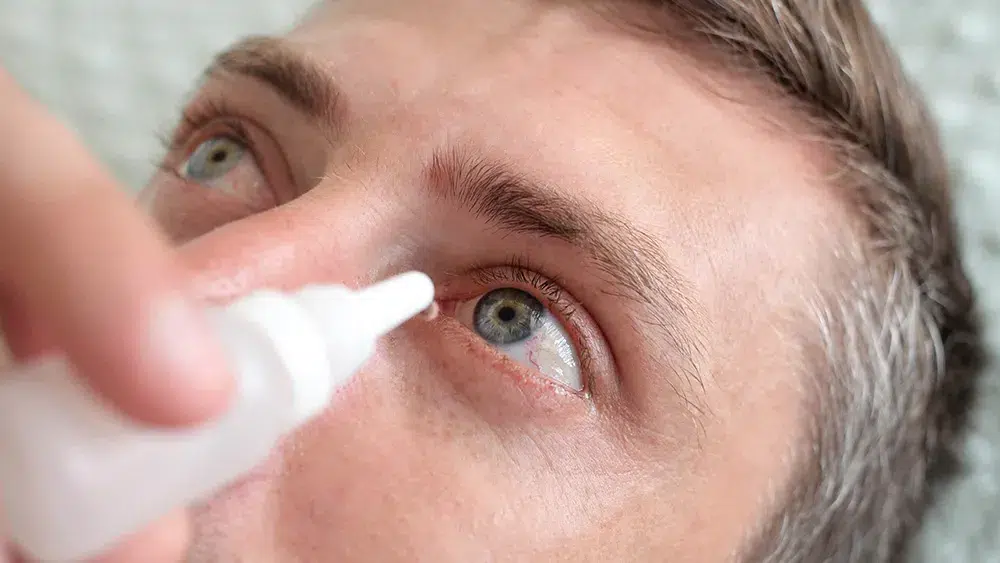
What Are Presbyopia Eye Drops and How Do They Work?
Presbyopia eye drops sharpen near vision by making your pupil smaller, borrowing the same principle that lets a camera’s narrow aperture keep more of a scene in focus. A smaller pupil filters out scattered light and deepens your range of clear vision, so close-up detail lands crisply on your retina. Ophthalmologists call this the “pinhole effect”; here’s how they work:
- The ring of muscle around your pupil (the iris sphincter) constricts, sharpening near focus while leaving your distance vision clear.
- Early formulas also stimulated the eye’s inner focusing muscle, sometimes causing a brow ache or brief distance blur. Newer, pupil-selective formulas leave that muscle alone, so most patients notice little more than the near-vision improvement itself.
- Depending on the drop, near vision sharpens within about 15 to 30 minutes and holds for several hours before gently returning to your starting point, so nothing about the drop is permanent.
This daily reset makes trying presbyopia eye drops a low-stakes decision, since you can adjust the dose or drop if it’s not quite right for you.
What Presbyopia Eye Drops Are FDA-Approved?
Four prescription eye drops for presbyopia have earned FDA approval, and while all four rely on the pinhole effect, they differ in their active ingredient, how long they last, and how they’re dosed:
- Vuity (pilocarpine 1.25%): The first FDA-approved presbyopia drop, cleared in 2021, and the one that proved a drop could stand in for readers. It’s dosed once daily and lasts up to 6 hours, with the option of a second drop a few hours later to extend the effect further.
- Qlosi (pilocarpine 0.4%): A low-dose, preservative-free pilocarpine drop built around comfort and flexibility. Its gentler concentration is among the best-tolerated in the class, delivers up to 8 hours of near vision with a two-dose regimen, and can be used once or twice daily, depending on your needs.
- VIZZ (aceclidine 1.44%): A once-daily drop built on aceclidine, an ingredient that’s pupil-selective by design. By narrowing the pupil while largely sparing the focusing muscle, it delivers some of the longest-lasting near vision in the category, up to 10 hours, on a single morning dose.
- Yuvezzi (carbachol and brimonidine tartrate): The first and only combination drop, cleared in January 2026. One ingredient constricts the pupil to create the pinhole effect, while the second opposes the pupil’s dilating muscle, keeping near vision sharp for hours on one daily drop while also helping keep eye redness down.
A fifth option, phentolamine, flips the approach: rather than triggering the muscle that constricts your pupil, it relaxes the muscle that widens it, letting the pupil narrow on its own for the same sharpening effect, without engaging the eye’s inner focusing muscle at all. Under FDA review for presbyopia with a decision expected in late 2026, it may carry less risk of the brow ache or brief distance blur some pupil-constricting drops cause.
What Are the Benefits of Presbyopia Eye Drops?
The appeal of eye drops for presbyopia is straightforward: near-vision freedom without a procedure or a permanent commitment. Their standout benefits include:
- Glasses-free near vision: Menus, medication labels, and phone screens come back into focus, so close-up tasks stop demanding a squint or an outstretched arm.
- All-day coverage from one routine: A single morning drop carries most patients through hours of reading, screen time, and errands, with no readers to misplace.
- Preserved distance vision: Because the drops work on pupil size rather than reshaping the eye, your far vision stays clear while your near vision sharpens.
- A non-surgical option: Drops require no incisions, no anesthesia, and no recovery time — an appealing entry point for patients curious about life beyond readers but not ready for a procedure.
- A low-risk trial run: Because the effect fades each day, drops let you test-drive sharper near vision and see how much you value it before considering a permanent solution.
What Are the Side Effects of Presbyopia Eye Drops?
Presbyopia eye drops carry a strong safety record: across the clinical trials behind their approval, they were well tolerated and produced no serious treatment-related adverse events. Additionally, the newer formulas are designed to further minimize any side effects of older drops. Most side effects are mild, temporary, and quick to fade as your eyes adjust:
- Mild and short-lived: A brief headache, slight dimness, temporary eye redness, or mild irritation as the drop goes in are the most common effects, and they typically ease within hours and lessen further over the first week or two.
- Low-light awareness: Because a smaller pupil lets in less light, night driving or dim rooms can feel slightly darker, so many patients give their eyes a day or two to adjust before driving after dark.
- Well-screened for peace of mind: A dilated eye exam before you start checks for the small set of pre-existing conditions worth knowing about first, such as a history of retinal problems, high nearsightedness, or a prior retinal tear.
Catching which side effects you’re likely to notice, and ruling out retinal risk factors like the ones above, is exactly what an eye exam is for. Once Dr. Corsini confirms you’re a good fit, he can match you to the specific drop, strength, and schedule best suited to your routine, so you never have to guess which option is best on your own.
Who Is a Good Candidate for Presbyopia Eye Drops?
The best candidates for presbyopia eye drops are adults 40 and older with mild-to-moderate near vision loss, clear distance vision, and healthy retinas who want to depend on their readers less often. A few factors help Dr. Corsini confirm the right fit and the right drop:
- Your degree of near-vision loss: eye drops for presbyopia work best for mild-to-moderate cases, which describes most patients in their 40s and 50s. If your near-vision loss is more advanced or a cataract is part of the picture, Dr. Corsini can discuss monovision, achieved through LASIK or PRK, or a referral for cataract care.
- When you need your near vision to be sharpest: All-day readers benefit from a longer-acting drop, while a morning meeting or an evening out may only need a shorter one.
- Your eye history and daily demands: Contact lens wear, recent eye surgery, previous eye inflammation, and how you spend your close-up hours all shape which drop and dosing plan fits you best. If you’re pregnant or nursing, Dr. Corsini will recommend holding your drops and will revisit the conversation when the timing is right.
“What I love about presbyopia eye drops is how low-commitment they are. One drop in the morning, and for the right patient, the reading glasses stop interrupting dinner, the grocery list, and the crossword. And if you find you love that freedom, it opens up a bigger conversation about making it permanent.” — Dr. Jonathan Corsini, Corsini Laser Eye Center.
Your Top Presbyopia Eye Drops Questions Answered
When patients weigh presbyopia eye drops, the same practical questions come up again and again. Here’s how Dr. Corsini answers the ones he hears most.
- Are Presbyopia Eye Drops Better Than Reading Glasses?Drops offer hands-free near vision that many patients prefer for daily tasks, while glasses provide consistent magnification you can count on at any time of day. In low light or for the finest print, glasses may still have the edge, and plenty of patients happily use both.
- How Much Do Presbyopia Eye Drops Cost, and Does Insurance Cover Them?Most insurance plans treat these drops as elective, so patients typically pay out of pocket, with pricing varying by drop and pharmacy. Manufacturer savings programs and discount cards can lower the monthly cost, and Dr. Corsini’s team can point you toward current options at your visit.
- Can I Use Presbyopia Eye Drops After LASIK or SMILE?Often, yes. Presbyopia develops with age regardless of past laser vision correction, so many patients who’ve had LASIK or SMILE remain good candidates. Because the drops change pupil size, share your surgical history with Dr. Corsini so he can confirm the best fit.
- Do Eye Drops for Presbyopia Replace Laser Vision Correction?Drops offer flexible, non-surgical relief, but they aren’t permanent and don’t stop presbyopia from progressing. For a lasting solution, laser vision correction can be tailored as blended vision, setting one eye for distance and one for near. Many patients treat drops as a low-risk “test drive” before choosing a permanent path.
Ready to See Near and Far, Minus the Readers? Book Your Complimentary Consultation
Every week, Dr. Corsini meets patients working toward the same thing: sharper near vision, minus the readers. Some are ready to try the simplicity of a daily presbyopia drop, while others want to talk through a more permanent solution. At Corsini Laser Eye Center, serving Wayne, King of Prussia, and the greater Philadelphia area, Dr. Corsini helps you find your fit one-on-one in a personalized, pressure-free evaluation. Schedule your complimentary consultation or call (484) 580-2166 to take your first step toward your personal “20/happy” vision.
Sources:
- FDA —Vuity (pilocarpine hydrochloride ophthalmic solution) 1.25% Prescribing Information, 2023
- FDA —Qlosi (pilocarpine hydrochloride ophthalmic solution) 0.4% Prescribing Information, 2023
- FDA —VIZZ (aceclidine ophthalmic solution) 1.44% Prescribing Information, 2025
- FDA —Yuvezzi (carbachol and brimonidine tartrate ophthalmic solution) 2.75%/0.1% Prescribing Information, 2026
- Viatris Newsroom —FDA Accepts Viatris Supplemental New Drug Application for MR-141 (Phentolamine Ophthalmic Solution 0.75%) for the Treatment of Presbyopia, 2026
- American Academy of Ophthalmology —Pilocarpine Drops for Presbyopia May Increase the Risk of Retinal Detachment
- PMC —Ophthalmovigilance in Pharmacotherapy of Presbyopia, 2025